
Pompano Beach Unveils Donated Memorial to 1776 First Amphibious Raid
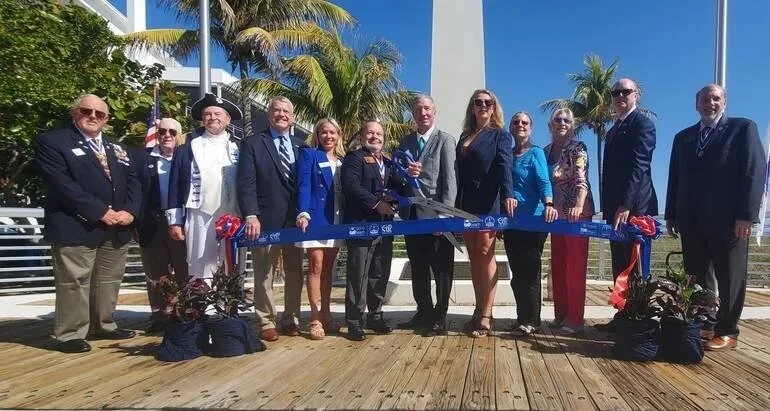
POMPANO BEACH — The sounds of Colonial-era fife and drum echoed along Pompano's beachfront on Saturday morning as a procession of men, dressed in the uniforms of Revolutionary War soldiers, paraded onto the Fisher Family Pier. The group, joined by a throng of more than 300 residents, curious visitors, and VIP guests, helped commemorate the city's newest and most unique donated monument.
First Amphibious Assault Memorial
Dressed in tri-corner hats and period-correct regimentals, members of the Florida Society of the Sons of the American Revolution (SAR) gathered to officially unveil the First Amphibious Assault Memorial. The 20-foot stone obelisk commemorates the Raid of Nassau - a successful, important - but historically-overlooked 1776 naval expedition to a British stronghold in the Bahamas to obtain much-needed gunpowder.In the early days of the war, a fledgling American naval force and a detachment of Continental Marines—the precursors to the modern U.S. Marine Corps—came ashore to target a British gunpowder stockpile and overwhelm its garrison of soldiers. The raid was a tactical triumph, netting roughly 8 tons of desperately-needed gunpowder for George Washington’s Continental Army.
Dressed in tri-corner hats and period-correct regimentals, members of the Florida Society of the Sons of the American Revolution (SAR) gathered to officially unveil the First Amphibious Assault Memorial.
The 20-foot stone obelisk commemorates the Raid of Nassau - a successful, important - but historically-overlooked 1776 naval expedition to a British stronghold in the Bahamas to obtain much-needed gunpowder.
In the early days of the war, a fledgling American naval force and a detachment of Continental Marines—the precursors to the modern U.S. Marine Corps—came ashore to target a British gunpowder stockpile and overwhelm its garrison of soldiers. The raid was a tactical triumph, netting roughly 8 tons of desperately-needed gunpowder for George Washington’s Continental Army.
How the Memorial Came to Pompano
So why was the monument placed in Pompano? While the battle took place across the Gulf Stream, organizers say they chose the city for its proximity to the site and the city's enthusiastic support.
"We were looking for a location, and the patriotism within Pompano Beach and the willingness of the city commission made this possible," said Steven DePaul, chairman of the First Amphibious Assault Memorial (FAAM) committee for the Florida Society of the Sons of the American Revolution
“This is a unique monument. There is no other dedication to this particular event in history," he said. The event also drew curious onlookers like Mary Allen Dacey, who - being a resident of the metro Boston area - knows plenty about Revolutionary War memorials.
“Everybody walks the fishing pier, including me. So we've watched this whole assembly of the monument, the flags, the whole thing,” said Dacey. “I've watched it come together in the last few months, so I didn't want to miss it. And being from New England, you know - we do a lot of Colonial reenactments,” she said.
Event Draws Residents and VIP Guests
The ceremony, which drew more than 300 guests, featured high-ranking military figures including retired USMC Major General James Hartsell; Michael Elston, President General of the Sons of the American Revolution; Broward County Commissioner and former Pompano mayor Lamar Fisher; and Mayor Rex Hardin.
“This was truly an inspiring event to make this happen for our 250th anniversary, the semi-quincentennial,” said Hardin. “This is something that is part of our history and will be part of our history forever going forward. And to memorialize the first amphibious landing of our forces, what a great event,” he said.
Donations Brought the Obelisk to Reality
Sons of the American Revolution representatives noted that the obelisk is the product of a two-year fundraising effort. While the city prepared the pier, creating a small portion of the structure available as a place of honor for the monument - the obelisk, its bronze plaques, and flanking flagstaffs were paid for through donations by SAR members and corporate donations to the organization.
SAR members said the monument will help the organization serve its educational mission. Christopher Washler, President of the Florida Society of SAR, noted that even seasoned history buffs are often unaware of the Nassau gunpowder raid.
"We forget American history far too easily," Washler said. "The number of blank stares I get when I ask about the first amphibious landing... it’s stunning to me. This is the least we could do for the Marine Corps and the country."
As the ceremony concluded, attendees lined up to place carnations at the base of the obelisk, a somber tribute to the "first of a first" that helped secure the ammunition necessary for American independence.